Updated:
| Quick answer
Patience in customer service works in two directions: how long customers will tolerate a delay, and how calmly staff handle customers while they wait. It matters because customers judge a brand by how a wait feels, not only by how long it lasts. Businesses that explain delays, show progress and give people something to do while they wait keep customers who would otherwise walk away, and that is now a real competitive advantage. |
|
In a hurry?
|
A delayed order, an unanswered call or a long line used to be a small annoyance. Today customers read it as a sign that a business does not value their time. In Qualtrics XM Institute research published in November 2025, 47% of more than 20,000 consumers in 14 countries said they cut their spending after a bad experience, putting nearly $3 trillion in sales at risk.
Delays are still unavoidable in retail, healthcare, banking, hospitality and telecom, where demand swings and processes are complex. What separates the brands that keep customers from the ones that lose them is how those waiting moments are handled. This guide explains why patience in customer service has become a deciding factor, the psychology behind it, what frontline teams and systems can do, and how Wavetec clients have turned waiting into a reason to stay. For the systems side, see Wavetec’s enterprise queue management system.
What Is Patience in Customer Service?
Patience in customer service has two sides. Customer patience is the tolerance a customer has for delays, waiting periods or slower service during an interaction. Staff patience is a frontline team’s ability to stay calm, listen and explain while a customer is frustrated, confused or in a hurry. Both shape whether the interaction ends well.
Customer patience depends less on the length of the wait and more on how manageable it feels. Unlike satisfaction, judged afterward, or loyalty, built over months, patience operates in the moment: when customers understand what is happening, tolerance goes up; when uncertainty takes over, even a short wait feels too long.
On-demand services have tightened expectations around time, which makes patience a core part of modern customer experience.
Why Is Patience Important in Customer Service?
Patience is important in customer service because it protects the relationship during the moments most likely to break it. A customer who stays calm through a delay gives the business time to fix the problem; one who runs out of patience leaves before the fix arrives. According to Zendesk’s customer experience statistics, 52% of customers will switch to a competitor after a single negative impression, and 72% want immediate service.
Patience pays off in five practical ways:
- It prevents escalation. A patient agent who acknowledges the delay stops frustration from turning into a complaint.
- It improves accuracy. Staff who are not rushing listen fully, ask the right questions and solve the right problem the first time.
- It protects loyalty. Zendesk also cites Forrester research showing customers are 2.4 times more likely to stay with a brand when their problems are solved quickly. Patience buys the time needed to solve them.
- It reduces repeat contacts. Informed customers do not call back or ask again.
- It shapes word of mouth. People retell how they were treated while they waited.
Why Customer Experience Is the New Competitive Advantage
Products, prices and service models are easier to copy than ever, so customer experience is where brands now compete. Patience sits at the center of that experience because it decides whether customers stay engaged when an interaction takes longer or needs more effort.
The financial case is clear. In January 2025, Forrester reported that firms can achieve up to 3.5 times the revenue growth when they improve brand experience and customer experience together rather than separately. High customer patience goes hand in hand with stronger Net Promoter Scores, lower churn and loyalty built on how people felt, not only on what they bought.
Companies that keep patience intact gain time to resolve issues properly. Those that fail often lose the customer before recovery is possible.
The Psychology Behind Customer Patience and Wait-Time Tolerance
Customer patience is shaped by how the brain reads time and control. The biggest factor is the gap between perceived and actual wait times: an uninformed customer feels a 5-minute wait as much longer. Clearly shared average wait times give customers a reference point and keep them calmer.
Service researcher David Maister set out the core rules in his 1985 paper The Psychology of Waiting Lines, and they still hold. The table below pairs each principle with what a business can do about it.
| Principle (Maister, 1985) | What it means for customers | What a business can do |
|---|---|---|
| Occupied time feels shorter than unoccupied time | Idle waiting drags | Content on screens, forms to complete, freedom to browse |
| People want to get started | Waiting before service feels worse than waiting during it | Instant check-in and a ticket at arrival |
| Anxiety makes waits seem longer | “Am I in the right line?” adds stress | Clear signage and confirmation messages |
| Uncertain waits feel longer than known waits | No estimate means no end in sight | Estimated wait time and position in line |
| Unexplained waits feel longer than explained waits | Silence reads as neglect | Short updates that say why the delay is happening |
| Unfair waits feel longer than equitable waits | Queue-jumping breaks trust | Visible, rules-based ticket order |
| The more valuable the service, the longer people will wait | Tolerance rises with the stakes | Explain the value of each step |
| Solo waits feel longer than group waits | Waiting alone feels isolating | Staff check-ins and a welcoming waiting area |
Unexpected delays also trigger stronger reactions than delays customers were warned about. Predictability lowers the mental load, which is why the psychology of queue management starts with information, not speed.
How Customer Patience Influences Trust, Loyalty, and Brand Perception
When waiting feels predictable and transparent, customers see the brand as reliable and considerate. Clear communication, visible progress and acknowledgment help customers feel valued rather than ignored, and a fair, transparent queue tells them the rules apply to everyone.
In healthcare, travel and banking, where long waits are common, the effect is stronger. Appointment delays and verification steps are often unavoidable, but how they are handled shapes long-term perception; in healthcare, the effect of waiting on patients reaches into trust in the provider itself. When patience breaks down, customers disengage before the service outcome has a chance to matter.
Industries Where Customer Patience Creates a Clear Competitive Edge
Patience matters most where waiting is a regular part of service. Delays cannot always be avoided, but how they are handled sets preferred brands apart.
- Healthcare: Appointment overruns and emergency room delays are common, and patient confidence depends on how clearly delays are explained. Providers who give updates and guidance keep patients calm, and digital patient check-in removes the first wait altogether.
- Retail: Checkout lines and fulfillment delays test tolerance at peak times. Retailers that show timing clearly prevent frustration and queue abandonment.
- Hospitality: Check-in and dining waits set first impressions; managing them signals order and care.
- Telecom: Store visits and troubleshooting take time; clear steps and updates reduce uncertainty during complex fixes.
- Banking: Branch queues and identity verification steps cannot always be skipped. Banks that handle them with clear pacing reduce dissatisfaction at sensitive moments.
In every one of these industries, the advantage comes from managing delays better than competitors, not from eliminating them.
How to Show Patience in Customer Service: What Frontline Staff Can Do
Staff patience is a skill that can be trained, not a personality trait. These five habits help frontline teams stay calm and keep customers calm with them:
- Acknowledge the wait first. Open with “Thanks for waiting, I know it has been a while” before getting to the task. Naming the delay lowers tension faster than ignoring it.
- Listen to the end. Let the customer finish before answering. Interrupting signals hurry and often leads to solving the wrong problem.
- Give a specific next step and time. “I will check with billing and come back to you within 10 minutes” beats “Please hold on.”
- Keep a steady tone. A slow, even voice and plain words calm an upset customer more than speed does.
- Follow up when you said you would. Keeping a small promise rebuilds trust after a delay.
Staff can only do this well when they are not overloaded and can see what is happening in the queue. That is why training staff for digitally supported service goes together with system design, and why a queue management system can improve staff performance by balancing workloads across counters.
7 Strategies Businesses Can Use to Increase Customer Patience
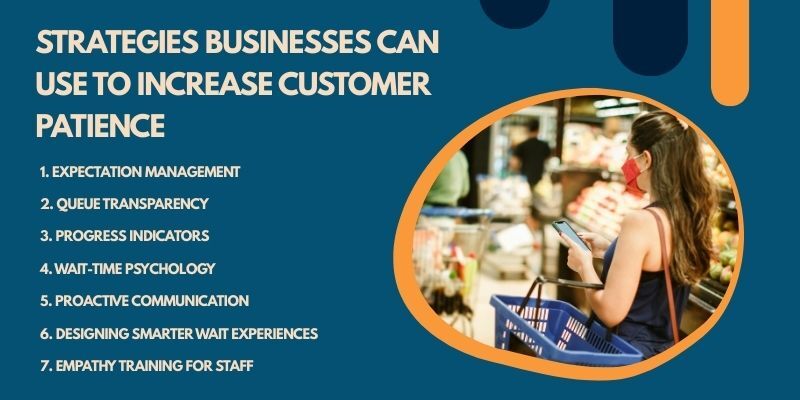
Businesses raise customer patience by designing waits that feel structured, informed and intentional.
1. Expectation Management
Setting expectations up front gives customers a reference point. When they know roughly how long a process will take, they are less likely to feel caught off guard. Even when waits run longer than ideal, predictability keeps customers engaged rather than frustrated.
2. Queue Transparency
Visibility into the queue reassures customers that the system is fair. Real-time updates by SMS, dynamic digital displays or apps reduce anxiety by showing progress. Transparency also cuts repeated questions, so customers can wait instead of chasing information.
3. Progress Indicators
Position-in-line updates and estimated time remaining give a sense of movement even when the line is slow. They remove the strain of wondering when service will start and stop time from feeling wasted.
4. Wait-Time Psychology
Idle waiting feels longer than purposeful waiting. Guided steps, short tasks or useful information make time feel productive. Our guide on how digital signage lessens perceived wait times shows the same effect in stores and branches.
5. Proactive Communication
Silence during a delay makes customers assume the worst. Brief updates, acknowledgments or apologies show the situation is being handled. Two-way SMS lets customers reply, reschedule or ask a question without losing their place.
6. Designing Smarter Wait Experiences
Good waiting environments give customers choices. Self-service options, remote check-in and the freedom to leave and come back give people control, and control makes waiting easier to accept. Virtual queuing takes this furthest: customers hold their place from their phone and arrive when it is nearly their turn.
7. Empathy Training for Staff
Frontline interactions shape emotional responses during delays. Staff trained to listen, acknowledge concerns and respond calmly ease tension quickly. A composed tone often matters more than speed, and real-time customer feedback on service quality shows managers where coaching is needed.
The Role of Technology in Extending Customer Patience
Technology helps businesses handle waiting moments consistently. The goal is not to make every service instant but to make sure customers always know what is happening and what comes next. Wavetec, which has deployed more than 30,000 systems in over 80 countries since 1986, builds these tools into one platform:
- Queue management system: organizes demand, issues tickets by service type and routes each customer to the right counter in a fair, visible order.
- Self-service kiosks: let customers check in, choose a service or complete simple tasks themselves, so the first wait starts with an action instead of a line.
- Remote joining: Mobile-Q and WhatsApp Queuing let customers take a ticket before they arrive and get alerts as their turn approaches.
- Donatello digital signage: shows called tickets, estimated waits and useful content on screens in the waiting area.
- Spectra queue analytics and reporting: gives managers live dashboards of queue length, wait and service times, so they can open counters before patience runs out.
- Customer feedback devices: capture how customers felt right after the wait, while the experience is fresh.
How the data connects: each ticket records when the customer arrived, when they were called and when service ended. Spectra turns those timestamps into live wait estimates for screens and messages, alerts managers when a queue passes a set threshold, and feeds historical patterns into planning. Wavetec’s AI Traffic Forecasting module, which ships with Spectra 2.0, uses that history to predict busy periods so staffing can be set in advance. Customers see an honest estimate; managers see the problem before customers feel it. Because kiosk, WhatsApp, mobile and SMS arrivals feed the same queue, the information stays consistent wherever the customer looks.
Not sure where your waits break down? See how Wavetec maps arrivals, waits and service across every branch.
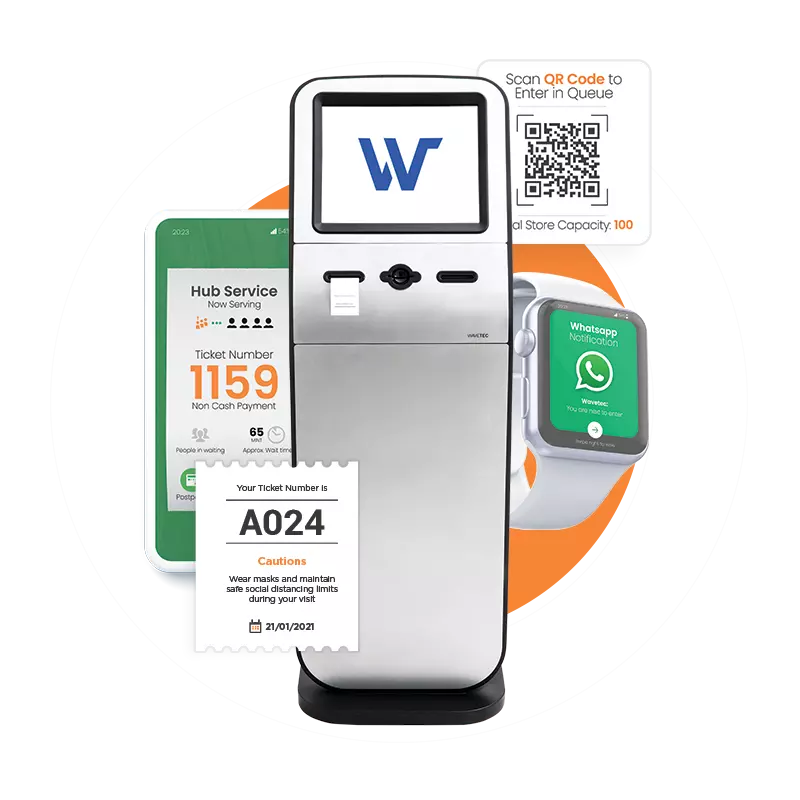
Turn every wait into a managed wait
Ticketing, live wait estimates, mobile and WhatsApp alerts and Spectra dashboards in one queue platform.
Unmanaged vs Managed Waiting: What Changes
| Moment | Unmanaged waiting | Managed waiting |
|---|---|---|
| Arrival | Customer guesses which line to join | Kiosk, QR or WhatsApp check-in issues a ticket for the right service |
| Wait estimate | None, or a vague “shouldn’t be long” | Estimated wait and position on screen and phone |
| During the wait | Customer stands in line, unable to leave | Customer sits, browses or steps out and gets an alert |
| Delays | Silence until the customer complains | Proactive message explaining the delay |
| Fairness | Queue-jumping and confusion | Visible, rules-based ticket order |
| Staffing | Managers react after lines form | Live dashboards and forecasts open counters in time |
| Feedback | Complaints arrive later, if at all | Rating captured right after service |
Customer Patience vs. Customer Speed
Many businesses still chase speed first, assuming faster service always means happier customers. Speed matters, but it does not decide how customers feel on its own. When expectations are unclear or communication breaks down, even quick service can feel rushed, impersonal or confusing.
A patience-first approach puts clarity, acknowledgment and guidance at the center, which often produces better experiences even when service takes longer. Efficiency keeps processes moving; patience-focused design keeps customers comfortable when delays happen. Brands that balance the two practice end-to-end customer experience management, judging service by how customers are treated at every stage. For the speed side, see our guide to reducing customer wait times.
How Leading Brands Turn Patience into a Competitive Weapon
Leading organizations use waiting moments to improve satisfaction and build loyalty. These examples start with Wavetec deployments.
Retail: Consum, Spain
At Spanish supermarket chain Consum, Wavetec’s queue management runs at the deli, meat and fish counters of more than 500 stores. Shoppers take a ticket at a branded kiosk or through the mobile app and keep shopping while screens show queue progress and estimated waits. According to the Consum case study, average waits fell from 12 minutes to under 5 minutes, and basket size rose 5 to 7% during peak hours. Patience turned into sales because waiting time became shopping time.
Banking: BBVA Peru
Across 278 branches, BBVA Peru uses Wavetec’s queue management system to organize branch traffic. The bank recorded about 35% lower average waits and 57% lower queue abandonment, with 99.93% system availability. Fewer customers gave up and left, which is the clearest sign that patience held.
Healthcare: Almoosa Specialist Hospital and Vaccination Centre
At Almoosa Specialist Hospital in Saudi Arabia, a 200-bed facility, three Wavetec kiosks helped cut waits from 30 to 45 minutes down to about 5 minutes, an 88% decrease. At the AlMoosa Covid-19 Vaccination Centre, structured queue flows, digital ticketing and clear service stages kept high visitor volumes calm and orderly. More examples sit in our hospital queue management system guide.
Airlines: Alaska Airlines
Airlines face weather and air traffic delays they cannot control, so communication is everything. According to Airship, more than 68% of Alaska Airlines’ 6.5 million active app users opt in to day-of-travel notifications, including real-time alerts on delays and gate changes. Travelers who know what is happening stay patient, even when the flight is late.
How to Measure Customer Patience
Patience cannot be measured directly, but its effects can. Track these indicators by location and time of day:
- Queue abandonment rate: the share of customers who take a ticket or join a line and leave before service. Rising abandonment means patience is running out.
- Promised vs. actual wait: the gap between the estimate shown and the real wait. A small, consistent gap builds trust; a large one destroys it.
- Average and longest wait: averages hide the worst cases, so watch the 90th percentile and the longest waits too.
- Satisfaction after the wait: a one-tap rating at the counter or by SMS, compared against wait time.
- Repeat contacts: customers calling or asking again about the same issue are a sign updates are not reaching them.
- Net Promoter Score by visit type: shows whether long-wait services drag loyalty down.
Our guide to queue management analytics KPIs explains how to set targets for each one.
6 Challenges Businesses Face When Managing Customer Patience
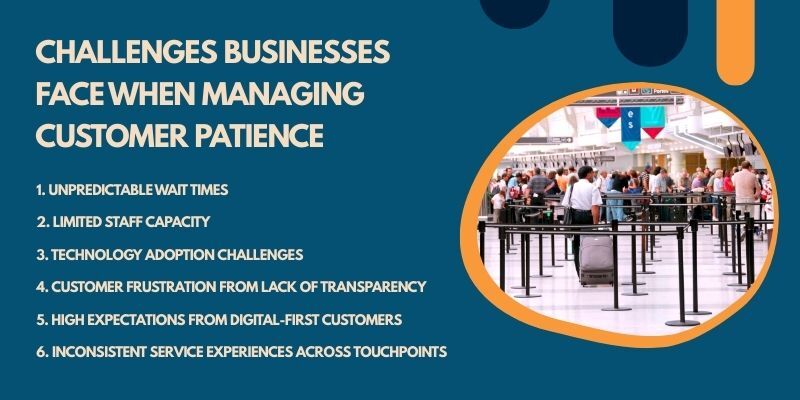
- Unpredictable wait times: Demand swings and interruptions make estimates hard, and a sudden change can leave customers feeling misled.
- Limited staff capacity: At peak times, stretched teams have less time to communicate, so frustration rises.
- Technology adoption problems: Systems that are not integrated, or staff not trained on them, produce inconsistent information.
- Lack of transparency: Customers who cannot see where they stand or why there is a delay feel the wait as longer.
- Digital-first expectations: People used to real-time tracking elsewhere have little tolerance for being left in the dark at a counter.
- Inconsistent channels: When the website, phone line and branch say different things, trust drops.
Patience needs coordination across operations, communication and design, not isolated fixes. Our guide to managing customer service queues covers the operational side.
Best Practices for a Patience-Optimized Customer Experience
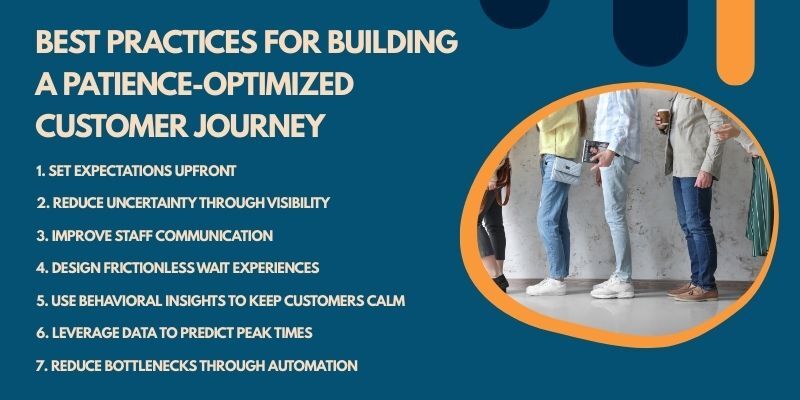
Use this checklist when you plan or review a service process:
- Map every wait point. List each place customers wait, from arrival to follow-up, and who owns it.
- Set and publish service-time targets. Decide what a good wait looks like for each service and show customers the estimate.
- Give staff a shared script for delays. Agree how to explain common delays so every customer hears the same clear message.
- Offer at least one way to wait remotely. Mobile, WhatsApp or SMS joining lets customers leave the line without losing their place; appointment booking removes the wait for planned visits.
- Use data to predict peaks. Historical arrival patterns and AI wait time prediction help plan staffing before pressure builds.
- Automate the repetitive steps. Self-service check-in and digital forms free staff for the conversations that need a person.
- Review the numbers every month. Compare abandonment, promised versus actual wait and post-wait satisfaction, then fix the worst location first.
Frequently Asked Questions (FAQs)
Where to Start: Make Your Next Wait Feel Shorter
Customer patience has become a competitive advantage because waiting is where customers decide whether a brand respects them. Start by measuring abandonment and the gap between promised and actual waits at your busiest location, then fix the first wait customers face with clear check-in, honest estimates and a way to wait remotely.
BOOK A FREE DEMO